Jacob’s Trauma Responses
Jacob's LadderJacob’s trauma responses are presented as both a rupture in his confidence and a continuing bodily reality: training and self-reliance do not prevent violence from overwhelming him, and its effects return through sound, sensation, and memory. His efforts to seek support and regain composure show not a clean break from the past, but the work of living with its recurrence.
The collapse of self-reliance
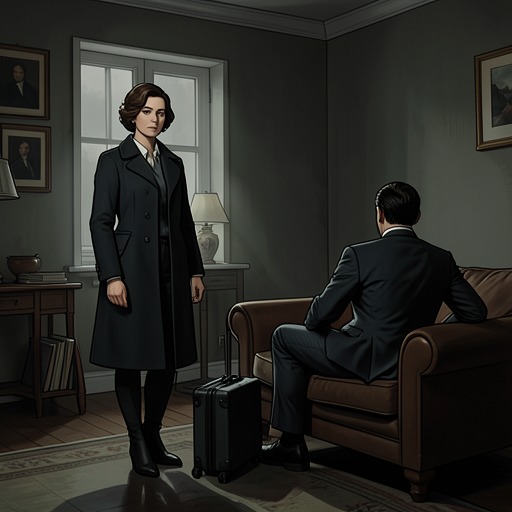
Jacob had considered himself capable of taking care of himself. He was attracted to large, forceful men such as Sander, but he was also trained in Krav Maga and believed he could always protect himself. That belief had held until Sander’s grip tightened and his face darkened with fury. Jacob describes the incident as something that could not have happened on an ordinary day; the contrast between that conviction and what did happen marks a break in his trust in his own ability to stay safe.
The important consequence is not that Jacob’s training was useless, but that it could not guarantee control over another person’s violence. His confidence had rested on the expectation that skill would let him manage danger. The assault unsettles that expectation, making the experience of being overpowered more than a physical injury: it also challenges the story he had told himself about being able to handle whatever came.
Entering support and facing speech
When Jacob is offered a domestic-violence support group in St. Nacho’s, the offer comes from someone who says that his work has brought him into contact with many difficult situations and that he has researched ways to help victims. Jacob does attend. At the first meeting, he holds his coffee among women seated in a small circle, all silent and visibly tense. He is unsure how he has arrived there, a hesitation that conveys the distance between being brought to a resource and feeling ready to use it.
The meeting does not require him to disclose his story at once. When he is told that he need not share that day, he stands so abruptly that his chair tips over and clatters across the quiet room. He bends to retrieve it. The small mishap gives the scene a physical expression of strain: the invitation to speak is met not with a composed account, but with a sudden movement and an effort to restore order. The group’s allowance for silence matters as much as the possibility of telling. Jacob’s presence there is already a step toward support, even while his readiness to speak remains uncertain.
Triggers and the body’s return to danger
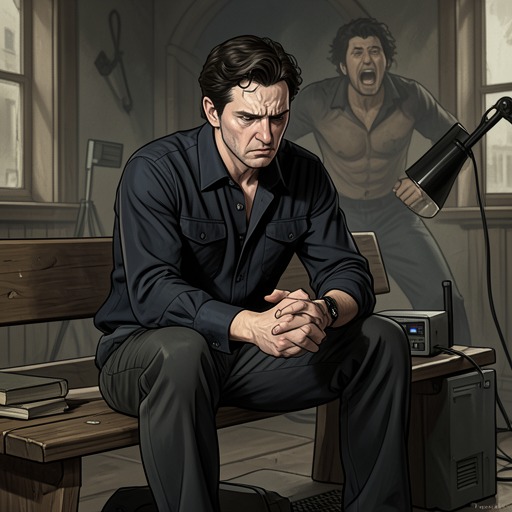
Jacob explains that the past can feel as if it is happening again rather than being remembered. He distinguishes the experience from a hallucination: it can feel more real than that, because the body reacts as though the danger is present. Adrenaline rises and fight-or-flight responses take over; he hears glass breaking and smells burning buildings. The sensations are vivid, yet he also recognizes that the event is not occurring in the present. That combination leaves him unable to rely easily on his senses.
The same pattern appears in an ordinary public setting. A sudden, sharp screech near him makes Jacob jump. He waves away the driver’s apologetic gesture, but his heart is racing, and he relives some of the worst moments of his life before he can steady his breathing. Loud noises, cars backfiring, and even the sound of breaking glass in restaurants can call up memories he would rather avoid. The range of triggers makes clear how violence can intrude without warning into settings that are not themselves dangerous.
These episodes also have duration. Jacob notes that it can be hard to remember where he is, and that the turmoil following a trigger often lasts for hours. His response is therefore not limited to the first startle: the sound can displace his sense of the present and leave him managing an extended aftermath. The novel gives that aftermath concrete sensory form rather than treating trauma as an abstract recollection.
Grounding, care, and an unfinished recovery
Walking toward the SeaView Motel through a sleepy St. Nacho’s helps ease Jacob after one such episode. He describes the surf’s push and pull as if it were drawing his anxiety out to sea. The contrast is striking: a sharp noise can pull the past into the present, while the steady movement of the shoreline helps him return to his surroundings. The relief is meaningful, but it is relief from an episode, not evidence that the triggers have disappeared.
Support and practical routines sit alongside these efforts at regulation. Jacob works baking pies with Mary Catherine Jensen and hopes his brother will come to get him on Friday. These plans do not resolve his trauma, but they place him within ordinary work and a possible family connection while his recovery remains in progress. In a later emergency, JT takes Jacob by the arm and directs him toward the triage tarps, explaining that he has to assess people according to their needs and that ambulances are on the way. The scene places Jacob near crisis again, but also shows care taking the form of clear direction in an urgent situation.
Across these moments, Jacob’s trauma is neither a single past event nor a condition that erases his capacity to act. He attends a support meeting, tries to regain his bearings after sensory reminders, and continues with work and relationships. Yet the returning sounds and bodily reactions preserve the difference between knowing that danger is over and feeling safe in the present. St. Nacho’s offers a temporary means of settling; it does not make the past cease to recur.